Showing posts with label book review. Show all posts
Tuesday, October 16, 2018
Skeletons in the Reacher Family Closet
Lee Child learned style from Hemingway. Or maybe from Elmore Leonard or Dashiell Hammett. He writes short, clean, sometimes incomplete but straight-to-the-point sentences. Brief paragraphs, plus almost as short episodic sections consisting of alternating points of view. Except when he writes long action sequences with lots of ands and Reacher did this and that and then his opponents fall down like flies after being sprayed with insecticide. Reacher gets knocked down, too, and instantly he’s back on his feet again. To stay down long means to die.
Hope for the best, plan for the worst.
Although the writing is often sparse and minimalist, it’s also detail-rich. Child pays close attention to tiny details, and so does protagonist Jack Reacher.
Past Tense (Delacorte Press/Random House, November 15, 2018) is Child’s 22nd Reacher thriller.
Patty Sundstrom and Shorty Fleck are a Canadian potato farmer and a timber sawmill worker on their way to NYC to sell something valuable enough to raise sufficient capital to start a new life in Florida. When their old car breaks down in the woods near Laconia, NH, not far from where Reacher’s father Stan was born and raised, they plan to spend only one night. Little do they know they might be trapped there for the rest of their lives.
Jack Reacher, walking and thumbing his way across America, sees a sign for Laconia and decides to visit the town where his father allegedly grew up. Of course, nothing is ever simple in a Jack Reacher novel. Hope for the best, plan for the worst.
It’s been said that Reacher walks where angels fear to tread. Whenever he encounters a wrong, he feels duty-bound by his own internal code of honor to set it right. Whenever he finds a bully picking on an underdog, he has to step in. He’s a giant of a man, both literally and figuratively. And when he gets mad, all hell can break loose.
Those are traits he inherited from his father.
Faithful readers will find many of the elements they expect in a great Reacher novel in the 400 pages of Past Tense: an intriguing mystery to solve (several, actually); plenty of broken noses and broken bones; bodies piled up like cordwood (some dead, others merely knocked unconscious); a beautiful female cop who proves not only extremely competent but an excellent foil for Reacher to toy with; plenty of bad guys and a few good guys Reacher needs to protect; a realistic threat to life and limb; and a get-out-of-town deadline. What makes Past Tense different, however, is the number of previously-unknown Reachers that may or may not be closely related to Jack.
Like all the other Lee Child novels, I couldn’t put this book down. The dramatic tension and anticipation of violence kept me devouring words. Learning more about the Reacher family was icing on the cake. Highly recommended.
Lee and me at Thrillerfest. I’m the guy wearing glasses.
Monday, September 17, 2018
A Sneak Peek into Harvard's Secret Societies
Allegedly based on facts, The Ancient Nine by Ian K. Smith (St. Martin’s Press, September 18, 2018) is actually a semi-autobiographical coming-of-age revelation of the ties that bind: love, friendship, family, social connections, and money.
As both an author of Lovecraftian-Mythos tales and a retired librarian, I was already familiar with Harvard’s Widener Library, the third largest library in the nation and, next to the fictional Miskatonic University Library’s restricted rare book room, one of the few repositories of the legendary Necronomicon. Imagine my pleasant surprise to discover the important roles rare books, grimoires, and libraries play in this intriguing new mystery novel set in and around hallowed Harvard Yard.
Spenser Quentin Collins, a financially-underprivileged African-American pre-med sophomore from the south side of Chicago, receives an unexpected engraved invitation to attend a cocktail party at the Delphic Club. One of the elite final clubs that serve Harvard students and alum in place of fraternities, the Delphic annually “punches” male sophomores as part of a highly secretive selection process of potential new members (not unlike fraternity rush week at state universities). Only those who prove worthy after three rounds of punch events are invited into the Delphic. Spenser, without family fortune or important social connections, can’t understand why he was punched by the Delphic. Is this a sick joke?
Since Spenser knows nothing about the final clubs, he begins to research the Delphic, first by asking other students, then by reading books and newspapers in Harvard’s many libraries. He discovers that a secret society called “The Ancient Nine” exists to protect the Delphic. He suspects the Ancient Nine may have deliberately and systematically covered up a student’s murder in the Delphic Mansion nearly a century ago. Why? Although he’s repeatedly warned to go with the flow and let sleeping dogs lie, he and a friend, Dalton Winthrop, continue to investigate the mysterious disappearance and the possible involvement of “The Ancient Nine.”
Spencer is followed, threatened, and fears for his own safety and the safety of his friends. Will the conspiracy of wealthy Harvard alums stop at nothing to keep their secrets?
Rich with descriptions of people, places, and things, The Ancient Nine offers history lessons to those interested in learning. All history is fiction. Even photographs reveal only the limited point of view of the photographer or the camera itself. Personally, I prefer to get my history lessons from novels. Don’t you?
Although The Ancient Nine is based on real places and events, it’s first and foremost a fast-paced thriller. It has characters you can care about, a mystery worth solving, and it’s not the author’s first novel. The Blackbird Papers, Smith’s previous excursion into fiction, is a well-written police procedural. His second novel is an even better read. Highly recommended.
Q & A with Dr. Ian K. Smith regarding THE ANCIENT NINE
- To begin with your beginnings, how did you get into writing?
and read John Grisham’s The Firm, long before it became the international
sensation. I enjoyed how that book made me feel, heart racing, unable to
focus on anything else but the book, literally reading pages while stopped at
traffic lights. I wanted to be able to create the same kind of story that
had a similar effect on someone else. I like stories. I like creating. I have
loved books my entire life. I decided that while my principle area of
academic study would be biology and eventually medicine, that I would always
keep an open mind and ambition to write and publish. That writing itch I
had harbored for so many years just never went away and I refused to ignore it.
Despite what many of my colleagues thought while I was in medical school, I
believed both medicine and creative writing could be pursued passionately in
parallel.
- You’ve written many bestselling books about health and nutrition. What made you decide to pivot and write a thriller now?
list for entertainment. I like to write what engages me, so I decided to
sit down and create a story in the fashion that I like to read them. I
love suspense and plots lines that are fast-moving and constantly make you
think. I like the feeling of not wanting to put a book down and getting excited
for the next time I have a break in my schedule to pick up that book again to
read the next chapter. I wrote my first novel, THE BLACKBIRD PAPERS back in 2004, a thriller based on the campus of Dartmouth College where I finished my first two years of medical school.
I had such great feedback from readers across the country. I would be on
tour for one of my health and wellness books and invariably, someone would come
up to me in the airport or a bookstore and ask me when I was going to write
another thriller, because they enjoyed THE BLACKBIRD PAPERS so much and
wanted more. Every time this happened, my heart would jump, and I would
profusely thank the person for reminding me of my other passion and my need to
go back to it and create more stories to share. I’ve been wanting to
publish another thriller for a long time, and this was the perfect time in my
career to do so. Fans of my fiction had waited long enough.
- This is a novel you “waited years to write.” What is it about this story that was
just begging to be told?
mystery, murder, suspense, history, and a love story. I’ve been writing
this book for more than 25 years. I started when I was a senior at Harvard.
While I was a very young and unpolished writer back then, I knew that it
was a story that was so compelling that it needed to be told, and I knew that
one day I’d be able to finish the story and publish it. This is a
fish-out-of-water story with a coming-of-age feel that I think will appeal to
people across the spectrum. Everyone likes a story about an underdog, and THE ANCIENT NINE captures that feel and spirit. I learned during my research
that no one had ever written extensively about the Harvard final clubs.
There were remote mentions in magazine and newspaper articles, but never
anything that really penetrated this rarefied world of power and privilege. I
just felt like this was a story begging to be told.
- What was your personal experience with “secret societies” like? How did you
decide what details to include as elements of the story in The Ancient Nine?
NOT be. I was the wrong color, no pedigree, blue-collar family, and
completely unaware of the elite circles in which these members traveled and
inhabited. When I started to understand the lineage of the members and
graduate members, I couldn’t understand why they would invite me to join. I
have always been sociable, easy-to-like kind of guy, but I didn’t fit the image
of a member nor did I have the money or access to privilege that the majority
of members had. I wanted to include the elements as I experienced them. I
wanted readers to see this world like I did for the first time, unsuspecting,
unexpecting, and undaunted. I met many great guys when I was a member and remain
friends with many of them to this day. Being a member was like a dual existence
on campus. I was a regular student like everyone else most of the time, then I
was a member of this final club that was a world of its own, including a staff
that served us in our mansion and dinners with wealthy, powerful alums who were
leaders of their fields throughout the country. I sat down to tables to
eat and share jokes with amazing men who were extremely successful and
influential, and at the same time fun to talk to and share experiences. Being a
member taught me a lot about life and discrepancies and how pivotal networking
can be as one tries to advance in life.
- The Delphic Club is a very important part of the story, just like the mysteries
around it. How did you come up with the mystery? Did you know how it would be solved from the beginning or did you come up with it as you wrote?
clubs—something that was very difficult to do since there has been very little
written about them through the years—I discovered some amazing occurrences and
legends not just about the clubs, but of Harvard itself. These
discoveries were like a small, unknotted thread that once I started pulling,
the story unraveled before me and everything began falling into place. I spent
a lot of time in libraries, in the stacks of Widener Library at Harvard and
Regenstein Library at the University of Chicago, digging into the historical
connections. It’s amazing how you can reach a point where a story can
actually write itself, and you just become the vessel through which it’s told,
trying your best to stay out of its way while you transcribe it as best as you
can without losing its feel and meaning.
- Have you received any negative feedback as a result of writing about your real-life experiences in these secretive organizations?
hit piece on the final clubs. This is a book that is based on real events,
secrets that have been tightly guarded for hundreds of years. As the clubs are
in serious and overdue conversations about opening their doors to a broader
membership, some of this information will enter the public forum much easier
and more fluidly than it has in the past. I would think that many current
and graduate members of the clubs will find this entertaining, especially since
they know very well the lay of the land on which the story is built.
- How much does the main character in The Ancient Nine have in common with
Ian Smith? How much of the story is autobiographical?
and experiences are based on mine. There are some creative changes I made
such as where he was from and some of the family dynamics, but a lot of who he
is and what he thinks is autobiographical. I’ve held on to this story for
a long time as I wrestled with the best way to tell it and when it should be
told. I was a tough, fearless kid who wanted to excel at everything and wanted
to make my single mother and family proud. For those times, I was not the
typical Harvard student—no trust fund or Ivy connection or renowned academic
family pedigree—but I had what was most important for a student from any walk
of life, the confidence that I could make it on Harvard’s storied campus.
I was unafraid to try new things, mix it up, and learn as much as I could.
I played sports intensely all my life, and I think that taught me a lot about
the world, our many differences, the rigors and benefits of competition, and
the importance of resiliency. I’ve never been one to be intimated by the chasm
between what I have and what others have. Spenser sees and feels the
world in exactly the same way as he remains proud of his humble beginnings and
constantly works to do what is right.
8. In this novel you introduce a highly varied cast of characters, ranging from
comical to mysterious, sporty to academic. Who was your favorite character to
write? Which one would you most likely want to grab a beer with?
A: This isn’t an easy question as it’s like asking you to
pick a favorite child. There are different things an author loves about
the characters he or she creates, and there are different reasons why the
characters appeal to the author. I will say, however, that it tends to be
fun to write about characters who are very different from who you are, because
it allows you to explore and imagine in a space that is not completely
familiar. Writing Ashley Garrett was a lot of fun. I liked and admired
her at lot. She’s from the other side of the tracks, brilliant, tough, witty,
romantic, and unimpressed. If I had a daughter, I’d want her to be like Ashley.
Dalton Winthrop was also a lot of fun to write, because he was
rich—something that I was definitely not—and rebellious and so determined to
cut his own way in life despite the overbearing expectations and interventions of
his imperious father. I don’t drink alcohol, but several of the real
people who the characters are based on I actually did sit down with over the
poker table and a box of pizza. I think it would be great fun to sit down to
dinner with the obscenely wealthy but uproariously gregarious graduate member
Weld Bickerstaff class of ’53 who lived in New York City. You just wind
him up and let him go.
- The Ancient Nine delves deep into the history and underbelly of Harvard. What was your process for researching this story?
of the less known facts about John Harvard’s book collection he donated to the
college and the infamous 1764 fire that destroyed almost all of it. Over
the years of writing this book I would find new pieces of information and the
web of history and mystery would grow even larger. Little is publicly known or
discussed about these clubs, and lots of secrets and knowledge have gone to the
grave with many of the graduate members. Harvard has one of the most
expansive library systems in the world, and I spent countless hours in many of
the libraries mentioned in the book, digging up old newspapers and magazines
and examining rare books. It was a lot of work, but a lot of fun at the same
time to connect the dots and delve into the layers of such an important
university and the secret societies that have long been a perpetual irritant to
the school’s administration.
- During your research, did you find out anything surprising that didn’t make it into the book?
on this book, but alas, an author must decide what to include and what to
discard. Those decisions were gut-wrenching at times, but for the sake of
the reader not having to sit down to a 600-page tome, the cuts had to be done.
One thing that surprised me that didn’t make it into the book was how
conflicted many of the school’s former leadership really were with regards to
the clubs. Many of them publicly spoke against the clubs and the need for
them to either be disbanded or opened to a more diverse membership, but
privately, these administrators and school trustees had been members of a club
themselves and as graduates, still supported them financially in ways that
their identities and participation wouldn’t be exposed.
- Readers will know you from your work in health and nutrition. In stepping away from that world, and into the world thriller writing, what surprised or challenged you the most?
genre of health and nutrition. I have enjoyed immensely helping and
empowering people. My books through the years have literally been life-changing
for millions of people. I’m grateful to have had the opportunity to
produce that type of impactful work. Writing thrillers has been equally
gratifying as it has allowed me to be more imaginative and tap deeper into my
creative side. I believe that a person can tap similarly and effectively
into the left (science, math) and right (creativity, arts) sides of the brain.
Contrary to what some have suggested, I don’t believe it’s one or the other.
One thing vastly different about writing thrillers is that the plots are
not linear, and therefore requires a vigilant attention to detail and great
effort to maintain continuity. There are all kinds of dead ends, interweaving
threads, surprises, disappointments, and moments of excitement that you must
work into the story, knowing that you need to entertain your reader and keep
them engaged for hundreds of pages. Accomplishing this is no small feat,
but the work it takes to achieve it is worth every grinding second of it once
you do.
- What’s next for you? Will you continue to write thrillers and do you have an idea for your next novel?
I love reading this genre, and I love writing it. My creative mind has a
natural proclivity for this type of storytelling. I’m currently working
on a different series of crime fiction/mystery books based on a character named
Ashe Cayne who’s an ex-Chicago police officer and now a private investigator.
I have learned a lot from my friends in CPD who have shown me the ropes
and explained procedure. Ashe is smart, sarcastic, handsome, tenacious, morally
compelled to right wrongs, broken-hearted, and a golf addict trying to bring
his scoring handicap into the single digits. I LOVE this character and
Chicago as the setting. The expansive, energetic, segregated, volatile,
notoriously corrupt Chicago becomes an important secondary character in the
book. Ashe Cayne takes on only select cases, and people of all walks of life
from all over the city come to him to get answers. The first book in the
series is called FLIGHT OF THE BUTTERFLY, and it’s about the
daughter of one of the city’s richest men who mysteriously goes missing on the
night she’s supposed to sleep over her best friend’s house. Her
aristocratic mother hires Ashe Cayne to find her missing daughter. But it’s a
lot more complicated than a missing person case. I expect to publish this book
in the fall of 2019.
Follow Dr. Ian on Instagram: @doctoriansmith
Twitter: @DrIanSmith
Facebook Page: The Ancient Nine
Monday, September 10, 2018
A brilliant, timely, and important story by a masterful storyteller
A Spark of Light by Jodi Picoult (Ballantine Books, October 2, 2018) is an amazing read. Not only does it reveal both sides of the abortion debate from the personal viewpoints of each of the main characters, it does so in an immediate life-and-death kind of way. Then the storyline begins to work backwards, hour by hour, to examine the choices that brought each of Picoult’s characters to this critical crossroads on the same day.
If only we were able to turn back the hands of time to choose over—to make vital decisions with the full knowledge of the consequences of our actions—would we make the same choices?
Do we ever really have a choice? Or do human beings only act out of necessity?
A Spark of Light tackles some heavy philosophical questions: When does viable life begin? Is it with the spark when sperm and egg meet? Is it at full-term birth? What are the responsibilities of parents? Of children? Of men to women? Of women to men? Of society to all children, whether born or unborn?
Of man to God? Of God to men and women? Of fathers to their offspring? Of women to their children? Of women to themselves?
A brilliant, timely, and important story by a masterful storyteller. Very highly recommended.
Saturday, June 9, 2018
Unputdownable
Lies by T. M. Logan (St. Martin’s Press, September 2018) piles complication atop complication atop complication as one lie leads to another and yet another.
Joe Lynch and his wife Melanie appear to be the perfect London couple, living a dream life. At least, Joe thinks so. They’ve been happily married nearly ten years and have a four-year-old son, William. Joe’s an English teacher at a private school, Mel’s an executive at a large retail chain. They own their house, two cars, and they have lots of friends.
Joe’s life begins to fall apart when he accidentally discovers Mel meeting her best friend’s husband at a motel bar. Ben Delaney is rich, handsome, smart, and ruthless. They have a super-smart fourteen-year-old daughter named Alice who sometimes baby-sits William. Ben and Beth have been married for 15 years, and Mel was maid of honor at their wedding. He’s owner and managing director of a software development company that specializes in creating computer games, and Ben loves to play games.
Why are Ben and Mel meeting at a motel when both are supposed to be working?
When Joe confronts Ben in the motel parking lot, Ben denies meeting Mel. Then he becomes angry and shoves Joe against his car. Joe shoves back, and Ben trips over his briefcase, loses his balance, and slams his head hard into the concrete. Blood oozes from his ear and Ben appears either unconscious or dead.
Joe tries to call an ambulance from his cell phone, but there’s no signal. William sees the blood and begins to suffer a severe asthma attack. Of course, Joe has forgotten to refill the inhaler he kept in the glove box, and he must drive William home and find another inhaler before the boy chokes to death. Save Ben or save his son? His son is infinitely more important.
When Joe returns to the parking lot to help Ben, the man and his Porsche are gone.
Mel returns home at her usual time on Thursday night. He mentions he’d seen her car at the motel and she quickly denies it, claiming she was playing tennis after work with Hilary Paine. When Joe insists he saw her with Ben, she admits she lied because Ben asked her to meet him to discuss a sensitive personnel problem she’d promised to keep secret.
Joe begins to have doubts: If his perfect wife lied to him, is then the rest of his perfect life also only a lie?
When Beth reports Ben missing to the police, Joe could become a suspect if he admits he was the last person to see Ben alive. Mel urges Joe to lie to the police, and things go rapidly downhill from there.
Joe turns to the internet to prove Ben is still alive, but technology is Ben’s strongpoint, not Joe’s. Someone has hacked Joe’s Facebook account and posted lies about him.
Told entirely in the first person from Joe’s POV, readers will easily identify with Joe and feel his pain as lie after lie comes to light and the noose is tightened around Joe’s neck. Is nothing and nobody what they seem?
Lies is a great read, fast-paced and unputdownable.
Tuesday, June 5, 2018
Raucously Funny
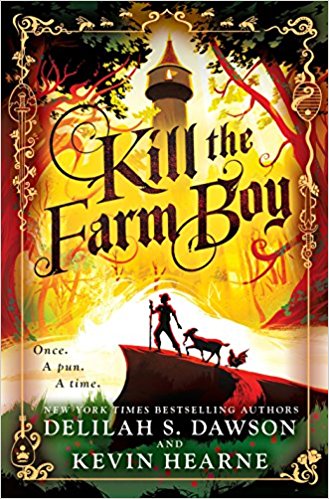
Kill the Farm Boy: Tales of Pell by Keven Hearne and Delilah S. Dawson (Del Rey, July 2018) is outrageously funny. It’s so tongue in cheek (which set of cheeks I am reluctant to say for fear of offending your sensibilities) that it’s like The Princess Bride on steroids.
Imagine making fun of literally every fairy tale trope. This can’t go on or I’ll die laughing, you’ll say, but it does. One bad pun follows another. 384 pages of side-splitting hilarity.
If you love epic fantasy, you’ll love this satiric novel. Not recommended for people with no sense of humor. Lots of fun for everyone else.
Tuesday, May 15, 2018
Jar of Hearts is a page-turner
Jar of Hearts by Jennifer Hillier (Minotaur Books, St. Martin’s Press, June 2018) is a cautionary tale about the consequences of lying. Lying to others, and lying to oneself. Sometimes lies will come back to haunt you. Sometimes they bite you in the butt when you least expect it.
Geo calls it Karma.
Georgina Shaw, Kaiser Brody, and Angela Wong are best friends. They’re normal sixteen-year-olds until they encounter Calvin James. Cal’s a 21-year-old bad boy who smokes cigarettes, chews cinnamon hearts, and hangs around local convenience store parking lots to sell drugs. Geo is naturally flattered when Cal pays her more attention than he pays Ang. There’s something about him that’s exciting and compelling.
And definitely dangerous.
She can’t help but fall in love with him. He knows exactly how and where to touch her to turn her on, and he never takes no for an answer. Suddenly, Calvin James is all she can think about.
Geo ignores her friends, ignores her schoolwork, even ignores cheerleading practice. Ang and Kai try to talk sense into her, but she can’t see the forest for the trees. She loves Calvin, and nothing else matters.
Fourteen years later, Kaiser Brody is the detective who arrests Calvin James, the Sweetbay Strangler. Kaiser also arrests Georgina Shaw as an accomplice to the murder and dismemberment of Angela Wong. Geo goes to prison for five years. Calvin goes to prison for life, but he escapes.
That’s just the backstory. The real story begins when Geo pleads guilty and goes to prison.
This story is about love and death and human relationships and compulsion and heartaches and heartbreaks and the mistakes we all make as we live and learn. It’s a hard-hitting look at the raw emotions that drive human behavior. It’s also about survival and what we all do to survive, not all of which is good or pretty. No one remains innocent nor guilt-free forever. Life quickly becomes complicated, and unintended consequences often develop when we’re not paying attention.
Jar of Hearts is a real eye-opener as well as a full-of-twists page-turner. Highly recommend for everyone but the faint of heart.
Monday, March 12, 2018
Somebody's Daughter is a Compelling Read
Somebody’s Daughter by David Bell (Berkley Books, July 2018) is about a missing nine-year-old girl and the petty jealousies and doubts that get in the way of relationships.
Erica, Michael Frasier’s first wife, is a bit of a drama queen. They’d married right out of college, a starter marriage, that ended in divorce a year later. Michael left Erica when her flightiness and impulsivity—two personality traits that had attracted him to her in the first place—became unbearable.
Michael’s new wife Angela is more like he is, a detail-oriented and responsible workaholic, not a wild and crazy emotionally-high-strung attention-seeking risk taker like Erica is or Michael’s sister Robyn was. Or his other younger sister, Lynne, a musician, song-writer, and former rock star still is. Robyn died when she fell off a swing set as an infant, and Michael blames himself for not preventing the fall. Although only a child himself at the time, he was the older brother and should have been watching out for his kid sister.
When Erica rings the doorbell at Michael and Angela’s house to announce her nine-year-old daughter is missing and Michael is Felicity’s father, he doesn’t know what to believe. He and Erica have been divorced nearly ten years, and this is the first he’s heard he might be a father. Angela and he have tried to get pregnant without success. Does he already have a daughter?
Or is Erica lying to get Michael’s attention? Is she trying to break up his marriage to get revenge for his leaving her? Or does Erica hope to get Michael back to be a father to their daughter?
Erica shows Michael Felicity’s picture on her cell phone. She looks remarkably like Robyn did the day before she died.
Parts of this novel read like a typical Jerry Springer episode. Who is Felicity’s father? What will a paternity test prove? Was Erica unfaithful while married to Michael? Inquiring minds want to know.
So do the local police when Erica reports Felicity abducted. Did Michael abduct his daughter? Did Erica abduct Felicity from another mother after Erica had a miscarriage ten years ago? Did a pedophile snatch the little girl when Erica’s attention was averted? Or did Angela, jealous that Erica gave Michael a child, abduct and kill Felicity because she couldn’t have children herself?
The author tosses in a few additional complications and a handful of supporting characters to keep the reader guessing. With every passing minute, the chances of finding Felicity alive become less and less. The timebomb is ticking. The sands in the hourglass are running out.
Somebody’s Daughter is a compelling read. Highly recommended.
Monday, March 5, 2018
Baby Teeth is a Must Read
Baby Teeth: A Novel by Zoje Stage (St. Martin’s Press, July 17, 2018) is every parent’s worst nightmare come true. Although seven-year-old Hanna displays the full spectrum of autistic behaviors like not vocalizing and destructive temper tantrums, she’s Daddy Alex’s little angel and Mommy Suzette’s devil in disguise.
Not unlike Bradbury’s “The Small Assassin” and Lionel Shriver’s We Need to Talk about Kevin, this is more than a simple story about parental denial of their child’s murderous intent. It’s an extended metaphor of human fears, human limitations, and our failure to communicate with each other in a meaningful way.
Just as there’s a good mommy and a bad mommy inside Suzette, there’s an evil, conniving, manipulative Hanna and there’s also the reincarnation of Marie-Anne Dufossete, a girl who was burned at the stake five centuries ago for witchcraft, for casting spells and poisoning people. Is Hanna possessed? Is the murderous Marie-Anne real? Or is she merely the sign of a personality split in a deeply-disturbed highly-imaginative seven=year-old?
As Hanna is expelled from school after school for violent behavior, Suzette is forced to home school her daughter. Hanna’s idea of fun, however, is to hurt other people, especially mommy. She plots to get mommy out of the way so she can have daddy all to herself. Alex, of course, refuses to believe Suzette when she tells him Hanna acts psychotic and needs professional help. When Alex is around, Hanna behaves like the loving daughter he wants her to be.
Stage effectively alternates chapters between Hanna’s POV and Suzette’s, allowing readers access to their innermost doubts and fears. It’s a brilliant kind of she said-she said non-verbal teeter-tottering that builds suspense all the way to the end and beyond.
Alex, born in Sweden (he insists his last name be pronounced Yensen, not Jensen), celebrates traditional Swedish pagan festivals, like building a Walpurgis bonfire on the night of April 30. He uses Swedish terms of endearment for both his wife and his daughter. Suzette, born in America of a Jewish mother and a mongrel father and raised by her grieving mother after her father’s untimely death, appreciates living in a multi-cultural household and learns enough Swedish to reciprocate. Hanna, too, knows Swedish as well as English, but she refuses to talk. She keeps her thoughts bottled up inside herself until they explode in violent outbursts directed at Suzette.
And when she does talk to Suzette, she speaks the French of a long-dead witch that was burned at the stake.
Baby Teeth is a must read for anyone who loves psychological suspense at its finest.
Friday, February 23, 2018
The Suspense Could Kill You
The thrill is back as Dean Koontz returns once again to the fast-paced protagonist-on-the-run roots that made his early novels so exciting and appealing. The Jane Hawk novels seamlessly cross genres, effortlessly moving from science fiction territory into that of James Bond’s espionage and modern techno-thrillers, from noir into pure psychological horror.
None of the characters in The Crooked Staircase by Dean Koontz (Random House, May 8, 2018) learned to play nice as children, and they certainly make reprehensible adults. Jane’s piano virtuoso father killed her mother and made life hell for the young girl, Booth Hendrickson’s mother made life hell for Booth and his half-brother, and the crooked staircase leads Jane and Booth straight down into a real-life hell from which only one may emerge alive.
Alternating short chapters between Jane Hawk’s POV and other viewpoint characters, including those hunting her, Koontz paints a horrifying picture of the worst abuses of government authority imaginable. Carter Jergen and Dubose are NSA employees who also work for the FBI, CIA, DHS, and IRS. They’re covert agents of the Techno Arcadians, a secret cabal of government and business elite who seek to control the world. They’re already in control of many world leaders, politicians and businessmen, implanted with nanotechnology that turns them into mindless slaves like modern-day Manchurian Candidates.
Dean pays tribute to Robert A. Heinlein, one of his mentors and idols, throughout this novel. Characters become strangers in a strange land, mannequins controlled by puppet-masters, Waldoes manipulated by monsters. Another of his idols, Charles Dickens, receives honorable mentions. And, of course, there’s always a faithful canine companion or two in a Dean Koontz novel.
We first met Jane Hawk in The Silent Corner (Bantam, June 2017) and continued her exciting adventures in The Whispering Room (Bantam, November 2017). In this third novel, The Crooked Staircase, former FBI Special Agent Jane is on the run from the Techno Arcadians while seeking revenge against those who killed her husband Nick. With son Travis safely hidden, Jane pursues Booth Hendrickson even as Hendrickson pursues her.
But bad guys Jergen and Dubose, two of the nastiest villains you never want to meet in a dark alley, are hot on Travis’ trail.
Will Jane survive descending the crooked staircase? Will Jergen and Dubose capture or kill Travis? You need to read the latest installment of the never-ending Jane Hawk saga to learn what happens next.
Or the suspense could kill you.
Thursday, February 8, 2018
Rip-Roaring SF Adventure
(Warning: Spoiler Alert!) Time Shards By Dana Fredsti and David Fitzgerald (Titan Books, February 2018) is the fast-paced kind of rip-roaring sf adventure Doctor Who fans will love. It’s set in England and includes a time-traveling doctor of astrophysics called Merlin capable of regeneration when killed and whose companions this episode are a present-day American college-age girl named Amber, an American journalist from the 1890s who calls herself Nellie Bly, a British WWII-era SAS commando named Blake, a bumbling Oxford professor who’s both a coward and a fraud, and a displaced Celtic Druid named Cam who speaks only archaic Welsh or Gaelic, plus a smattering of imperial Latin.
Amber, attending a cosplay convention in England, is ill-prepared to survive the cataclysmic event that first shatters earth’s time-line and then jams broken pieces back together in random order. Now dinosaurs roam the English countryside, Cromwell’s roundheads burn witches at the stake, and giant scorpions prowl the woods.
Amber stumbles from one horror into another, only to be saved at the last possible moment by Blake or Nellie or Cam or Merlin. Cam thinks Amber’s a faery queen when they first meet because of her cosplay costume. Although he’s technically two thousand years older than her, they appear to be the same age and he becomes enamored of her charms.
Stearne, a 17th Century roundhead witch-finder, believes her a witch because of her costume. He spends half the book trying to torture her or pursuing Amber and her companions to tie them all to stakes and burn them as witches.
The story is a wonderful blend of adventure and history lesson that’s a joy to read. My only disappointment came during the final pages when it was evident I would need to buy at least one more book in the series to learn all the answers and find resolution. Can Doctor Merlin restore the time-line? Will technology be the savior of mankind or its destroyer? Inquiring minds want to know, and I will buy the next book because I love the characters and care about what happens next.
Monday, December 25, 2017
4 Outstanding Stories in Dark Screams 9
Dark Screams: Volume Nine edited by Brian James Freeman and Richard Chizmar (Hydra, January 2018) includes three new stories and three stories originally published in Cemetery Dance Magazine. Since the editors of Cemetery Dance edit this anthology series, it’s easy to see how they’re able to put out dozens of anthologies in just a few years and edit a magazine, too. They have twenty-five years of reprints to choose from and only need to add three new tales to create an anthology.
There are four outstanding stories in this anthology.
Best of the bunch is “Torn” by Lee Thomas. Although it’s a reprint from 2012, it has a great plot embellished with all of the tricks of the storyteller’s art: fully-developed characters, multiple mysteries to solve, dire time constraints, apt metaphors, and believable personal conflicts between husband and wife, neighbors, and first responders. It’s the longest story in the book, and it’s an almost perfect story of human compulsion and how compulsion can tear a person apart. Sheriff Bill Cranston fights monsters to save his family and his town, and the monsters are a lot different than anyone expects.
Almost as strong but not as long, “The Blackout” by Jonathan Moore is an original supernatural revenge tale that reads like a police procedural. Detective Nakamura investigates the disappearance of a girl’s corpse during a storm that’s blacked out electrical power in Hawaii and finds more in the dark than he bargained for.
“The Dead Years” by Taylor Grant is a haunting tale of a modern-day Helen of Troy and the price of beauty. It’s also original to this anthology.
“Invitation to the Game” by Kelley Armstrong is well-written and suspenseful with a couple of nice twists. It’s also original.
“Summer of ‘77” by Stewart O’Nan and “Variations on a Theme from Seinfeld” by Peter Straub, both reprints from 2009, were competent but disappointing.
The four outstanding tales make Dark Screams: Volume Nine worth the price. Consider the other two stories an added bonus. Highly recommended.
Friday, December 15, 2017
Perfect Spy Novel
Need to Know by Karen Cleveland (Ballantine Books, January 2018) is the perfect spy novel, told from the POV of Vivian Miller, an American CIA counter-intelligence analyst, who has just discovered her husband, the father of her four children, is an embedded Russian spy.
Has Matt been manipulating her since they met? Is their ten-year marriage a lie? When she confronts him, he admits being a spy but claims he truly loves her and the kids, has never passed anything she’s told him on to the Russians, and he urges her to turn him in.
Viv knows she should turn Matt in, send him to prison for life. But she also knows she needs him to help her take care of their children, needs his income to pay the bills; worries she’ll lose her security clearance if her boss learns she was married to a spy; and doesn’t want to live without the man she loves by her side.
The conflict is real, the tension palpable. The stakes continue to grow as Viv makes one bad decision, then another. She becomes a traitor to her country, deleting Matt’s picture from the computers at the CIA, and plays into Russian hands. They own her. If she doesn’t do what they ask, they will reveal what she has done and she’ll go to prison along with Matt.
When she refuses to insert a flash drive that will give Russia access to CIA computers, Russian spymaster Yury threatens Vivian’s children. Viv feels trapped between the devil and the deep blue sea, damned if she does and damned if she doesn’t.
Is there no way out of the hole she’s dug herself into?
Vivian and Matt are complex characters readers can identify with, juggling personal lives with professional responsibilities. Which is more important: allegiance to spouse and children or allegiance to one’s country? Which vows take precedence: the marriage vows or the vows to protect classified information?
Impossible to put down, Need to Know is masterfully written. I recommend it highly.
Need to Know by Karen Cleveland (Ballantine Books, January 2018) is the perfect spy novel, told from the POV of Vivian Miller, an American CIA counter-intelligence analyst, who has just discovered her husband, the father of her four children, is an embedded Russian spy.
Has Matt been manipulating her since they met? Is their ten-year marriage a lie? When she confronts him, he admits being a spy but claims he truly loves her and the kids, has never passed anything she’s told him on to the Russians, and he urges her to turn him in.
Viv knows she should turn Matt in, send him to prison for life. But she also knows she needs him to help her take care of their children, needs his income to pay the bills; worries she’ll lose her security clearance if her boss learns she was married to a spy; and doesn’t want to live without the man she loves by her side.
The conflict is real, the tension palpable. The stakes continue to grow as Viv makes one bad decision, then another. She becomes a traitor to her country, deleting Matt’s picture from the computers at the CIA, and plays into Russian hands. They own her. If she doesn’t do what they ask, they will reveal what she has done and she’ll go to prison along with Matt.
When she refuses to insert a flash drive that will give Russia access to CIA computers, Russian spymaster Yury threatens Vivian’s children. Viv feels trapped between the devil and the deep blue sea, damned if she does and damned if she doesn’t.
Is there no way out of the hole she’s dug herself into?
Vivian and Matt are complex characters readers can identify with, juggling personal lives with professional responsibilities. Which is more important: allegiance to spouse and children or allegiance to one’s country? Which vows take precedence: the marriage vows or the vows to protect classified information?
Impossible to put down, Need to Know is masterfully written. I recommend it highly.
Tuesday, December 5, 2017
Best Frame Story I've Read
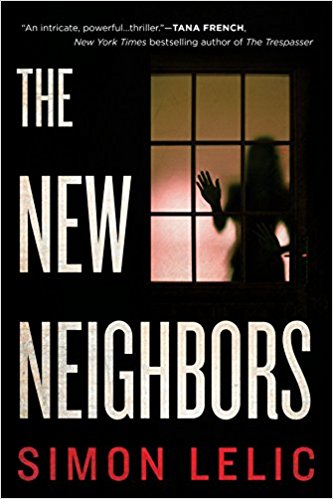
The New Neighbors by Simon Lelic (Berkley, April 2018) isn’t a ghost story. It is a lot like a ghost story, though, because main characters are haunted by skeletons in their own closets.
And it’s like a haunted house tale, because there are strange things in their new house that go bump in the night. There’s also a dead cat in the attic, for example, and a child’s treasure box. There are stuffed owls and strange pictures on the walls allegedly left behind by the previous owner.
It’s really a story about relationships. That fact is brought home right from the beginning by framing alternating chapters with Jack’s confessional letters to Syd, and then Syd’s written reply to Jack, using he said/she said as a device for story reveals. It’s the best frame story I’ve read in a long time. You know what I mean by frame story, don’t you? Of course, you do.
Jack and Syd are only a little suspicious when they acquire their new house for a song, because they’re unwilling to look a gift horse (or gift house) in the mouth. Why should they?
And when all that could possibly go wrong suddenly does, Jack and Syd naturally blame each other and not the house. Jack also blames Bart, his best friend and co-worker. And his nearest neighbor, Elsie’s father.
Syd, of course, blames Jack.
Elsie is the teen girl next door Syd befriends because, like Syd, her father physically and mentally abuses her. Elsie reminds Syd of Jessica, her younger sister, who committed suicide when Syd left home in her teens.
The New Neighbors is also a murder mystery, a whodunit, as well as a nearly-perfect frame story. Brits love a good mystery, don’t they? Almost as much as they enjoy a good ghost story or haunted house tale.
Both Jack and Syd have been insecure since childhood, and that leads them to withhold information and tell lies. And makes it easy for them to wind up in a hellish situation. Relationships are always complicated anyway, aren’t they? But being deprived of parental love while growing up only makes matters worse.
The New Neighbors is a bloody good read. Very highly recommended.
Thursday, August 31, 2017
The Fae don’t play nice. October Daye should know that by now, being half-human and half Faerie. But where her mother’s concerned, Toby can’t think logically. In The Brightest Fell (DAW, September 7, 2017), Book 11 of the October Daye series, Hugo-Award-Winning Author Seanan McGuire sends October in search of a long-lost half-sister. When mother politely asks Toby to put her PI skills to work to find August, she refuses.
Amandine, one of the Full-Blood Fae and Daoine Sidhe, isn’t used to being refused and won’t take no for an answer. To force her younger daughter to obey, she imprisons Toby’s fiance, Tybalt, plus another of Toby’s friends and takes them both hostage. Many of the characters from previous novels in this series, both friends and former enemies (including Simon Torquill from Rosemary and Rue), aid October’s quest into deep faerie to retrieve sister August.
Readers of Jim Butcher’s The Dresden Files will love McGuire’s Daye tales as much as, if not more than, Dresden, because Harry is currently missing, burnt out, or presumed dead while Daye becomes more and more immortal—and memorable—with every new novel.
Both urban fantasies have first-person narratives riddled with self-deprecating humor as well as suspense. Both heroes are PIs (private paranormal investigators). Harry’s entry to Faerie is Chicago; Toby’s is San Francisco. Both have half-siblings as antagonists who become occasional allies. Both frequent a restaurant where preternatural folk gather: Harry’s is a local bar; Toby’s is Borderlands Cafe and Bookstore. But the two heroes are actually as different as Knight and Daye, because Dresden’s story is told from a male viewpoint while Daye’s is decidedly feminine.
Ever since Spenser reinvented the sword and sorcery genre with the publication of the Faerie Queene in 1590, English-language writers have been embellishing on his themes and characters. Although the fairy tales most Americans are familiar with originated as Irish, Scottish, Welsh, or Germanic folk tales as retold by Victorian writers like J. M. Barrie, Spenser’s heroes are not entirely forgotten. The heroic quest of Britomart—the heroine’s journey—accompanied by her faithful squire, becomes Toby’s journey-quest on faerie’s Babylon Road (much like Dorothy and her companions following the yellow brick road into the Land of Oz to find a wizard), accompanied by Simon and Quentin.
What is it that attracts us to Faerie Tales? Is it a memory, embedded deep within human DNA, inside our very blood, of a long-ago time when magic was real and women ruled the world? Magic is a Ma word, you realize, because the first true practitioners were women. Magic flows from the Mother to her children through her blood, her breast-milk, and her songs. Men have no magic of their own except what they inherit from their mothers.
Magic lives in the blood. True magic is blood magic, and true enchantment is lyrical.
Magic is never free. There’s always a painful fee to be paid when employing magic to acquire what you desire. In fact, the Fae are sometimes called The Fee. They are sometimes also known as The Fates or as The Furies, but that’s another story.
Fae Magic always smells like it’s composed of a mixture of the alchemical essence of a living plant combined with something else, like rosemary and rue, and it also has a shape one can touch, a thread to ravel or unravel.
Toby’s unique gift, inherited from her mother, is her ability to smell or taste magic. She can differentiate odors like artists differentiate shapes and colors. She can track scents like a bloodhound or a Cu Sidhe (a Faerie dog). She can also retrieve memories from the blood of others, even the dead.
The October Daye novels may seem confusing unless you understand the familial connections of characters. McGuire includes a helpful prologue in this novel to aid you. Faerie is not unlike medieval Europe where all the royals are related by blood and bastards of kings and queens abound. Bloodlines become important for more reasons than one. There are Firstbloods and Purebloods and mixed bloods (part fae and part human) known as Changelings. October is a Changeling (daughter of Amandine and a human), while August is a Pureblood (daughter of Amandine and Simon Torquill). Descendancy shouldn’t matter in modern-day America, but it sure did in England, Scotland, Wales, and Ireland during the late Elizabethan period (and in George R.R. Martin’s Westeros of Game of Thrones fame). McGuire boldly explores the meaning of family—blood families, marital families and extended families of choice—in her Daye novels.
The Brightest Fell is very highly recommended, as is the entire October Daye series.
Thursday, August 10, 2017
Great Mystery, Superb Suspense
The Other Girl by Erica Spindler (St. Martin’s Press, August 22, 2017) is a great mystery story, expertly crafted.
Miranda “Randi” Rader and Jake Billings, police detectives in rural Louisiana, investigate the murder and mutilation of a college professor. Before Miranda became a cop, she’d been a victim herself of kidnapping and attempted sexual assault. Evidence found at the murder scene leads her to believe the professor, who is also the college president’s son, was the man who abducted her and another girl fourteen years ago.
Spindler builds suspense by piling up more and more evidence that points fingers at the wrong people, including Randi. Is someone trying to frame her for murder? Who? Why?
No one seems to believe Randi (Miranda), except her partner Jake and her best-friend Summer. She’s removed from the case and suspended from the department. She has to hire an attorney because she’s about to be arrested for murder.
Things go from bad to worse. Miranda learns Summer has an inoperable brain tumor and is going to die. Randi’s brother informs her their estranged mother is in the hospital recovering from a heart attack.
And when she and Jake fall in love, it only complicates things even more.
There’s an old saying among suspense writers that when your protagonist is hip-deep in alligators, you should throw a back-biting poisonous snake into the mix to add excitement. Spindler does that in The Other Girl, only she throws in more than one. Miranda doesn’t know (nor does the reader) she’s about to be bit in the butt until the snake strikes.
Great mystery, superb suspense. The Other Girl is a page-turner you won’t be able to put down until the very end.
Tuesday, August 8, 2017
A Perfect Obsession by Heather Graham
A Perfect Obsession by Heather Graham (Mira, April 2017) is full of surprises. The first surprise is discovery of supermodel Jeanette Gilbert’s body in a crypt below an old church. The second surprise is Kieran Finnegan’s twin brother Kevin is the “Mystery Man” Jeanette’s been secretly dating. The third is FBI special agent, and Kieran’s boyfriend, Craig Frasier being assigned to the case.
And the surprises just keep on coming as one beautiful corpse after another gets unearthed, proving a serial killer is loose beneath the crowded streets of New York City.
Graham loves to include history and geography lessons in each of her novels, blending fact with fiction whenever she can. But this is first and foremost a murder mystery Kieran and Craig must solve before Kieran becomes a victim herself.
It’s no surprise that A Perfect Obsession is part of a series. Graham has fully developed the Finnegan family, the bar they own, and the regulars who frequent Finnegan’s Irish Pub into something special. Kieran’s day job as a forensic psychologist and her night job as a bar maid, Craig’s job as an FBI agent, Kevin’s roles on Broadway and film, and Danny’s tour guide business are icings on the cake (or, in this case, suds on the Guinness). The pub and the city of New York overshadow everything that happens.
An exciting and fun read by a mistress of suspense.
Friday, August 4, 2017
Zippered Flesh 3
Zippered Flesh 3: Yet More Tales of Body Enhancements Gone Bad, edited by Weldon Burge (Smart Rhino Publications, October, 2017), contains nineteen stories, more than half of which are new. Reprints are by Billie Sue Mosiman, William F. Nolan, Jason V. Brock, Jack Ketchum, Graham Masterton, Sandra R. Campbell, and James Dorr.
The book leads with Mosiman’s “Horns, Teeth, and Knobs”, a viciously twisted tale with a shocking ending. Billie Sue is a wonderful writer, and this story showcases her skills. It’ll make you think twice about who your real friends are.
“Upgraded” by Shaun Meeks is about teenaged angst over acquiring the latest and greatest electronic gadget. “Going Green” by Christine Morgan has a similar theme, but it’s as different as night from day, the language rich and verdant, the futuristic gizmos even farther outside the box. “Worm” by Jeff Menapace leaves one feeling hungry. “Reduced to Tears” by Adrian Ludens turns body mutilation into a religious observance, proving less is more.
“A New Man” by William F. Nolan tells what bad things might happen if there’s a high-tech software glitch. “Transposition” by Jason V. Brock tells of a face-transplant gone terribly wrong. “The Rose” by Jack Ketchum is about a rose tattoo come to life. “Consume” by Daniel I. Russell is another “less is more” story with scary religious overtones of a supernatural nature.
“All Will Turn to Gray” by Jezzy Wolfe is a remarkable story, textured in rich hues and overtones unlike anything you’ve seen before. “Invisible” by E. A. Black is a meaty tale of repressed anger. “And the Sky was Full of Angels” by L. L. Soares is about coming home from war a changed man. “Shopping Spree” by Meghan Arcuri imagines Photoshopping people. “Closer” by Charles Colyott is a wonderfully poignant and romantic story you really should read. It’s the perfect emotional segue to “Dog Days” by Graham Masterton, another real tear-jerker.
“Switch” by Jasper Bark is extreme horror, very graphic, that may offend some readers. But Krasinski is a real asshole in more ways than one, and he deserves whatever bad juju or bad dodo comes his way. “Hypochondria” by Michael Zeigler tenderly tells of the dangers of medical misdiagnosis and afflictions of the heart. “Gehenna Division, Case #609” by Sandra R. Campbell furnishes a guided tour though Hell. And “Golden Age” by James Dorr celebrates the pioneering tradition that connects past generations with future generations.
My three favorite stories are: “All Will Turn to Gray” by Wolfe, “Horns, Teeth, and Knobs” by Mosiman, and “Shopping Spree” by Arcuri. “Dog Days” by Masterton is also exceptional, and one of the most satisfying stories I’ve read this year. “Going Green” by Morgan is so original, timely, and well-written it deserves special mention (and maybe a Stoker). Kudos to Burge for putting together another fine anthology of cutting-edge fiction.
Monday, July 31, 2017
One hell of a weird story! Surreal and spellbinding. Johnny Worthen’s What Immortal Hand is the darkest tale I’ve read in a long time.
Johnny Worthen’s What Immortal Hand (Omnium Gatherum, October 2017) is one hell of a weird story. It’s the darkest horror I’ve read in a long time.
Michael Oswald stares into the Abyss. He’s already lost his wife, his home, his kids, and now he’s about to lose his job. He feels himself on a slippery slope sliding into nothingness. His self-destruction is nearly complete. He feels as if he has no past, no future. It’s as if time itself plays tricks on him. He loses hours, days, weeks, maybe even years.
He can’t remember his early childhood the way other people can. He can’t even remember half of what happened yesterday. To the world, Michael Oswald is a loser because he values none of the trappings of civilized society. Michael has always been different than others. He believes it’s because he was raised within the foster care system, a ward of the state. He’s had many names, a different last name each time he entered a new foster home, and he has no idea at all who he truly is, who his real parents are, or who raised him during those influential years from three to seven.
Who is he? Where is he? When is he?
What is he?
All his life, it seems, Michael has been aware that there is a caste system—a natural order—at work in the world, even in democratic America. There’s always been haves and have-nots. There’s always been thugs who prey on Travelers. Some people deserve to die and need to be killed as a public service. But, in the end, all living things must die.
If God gives you lemons, get another god. Everyone is born of a Mother, isn’t he or she? And isn’t everyone reborn again and again?
Heh heh.
One hell of a weird story! Surreal and spellbinding. Johnny Worthen’s What Immortal Hand is the darkest tale I’ve read in a long time.
Subscribe to:
Posts (Atom)